
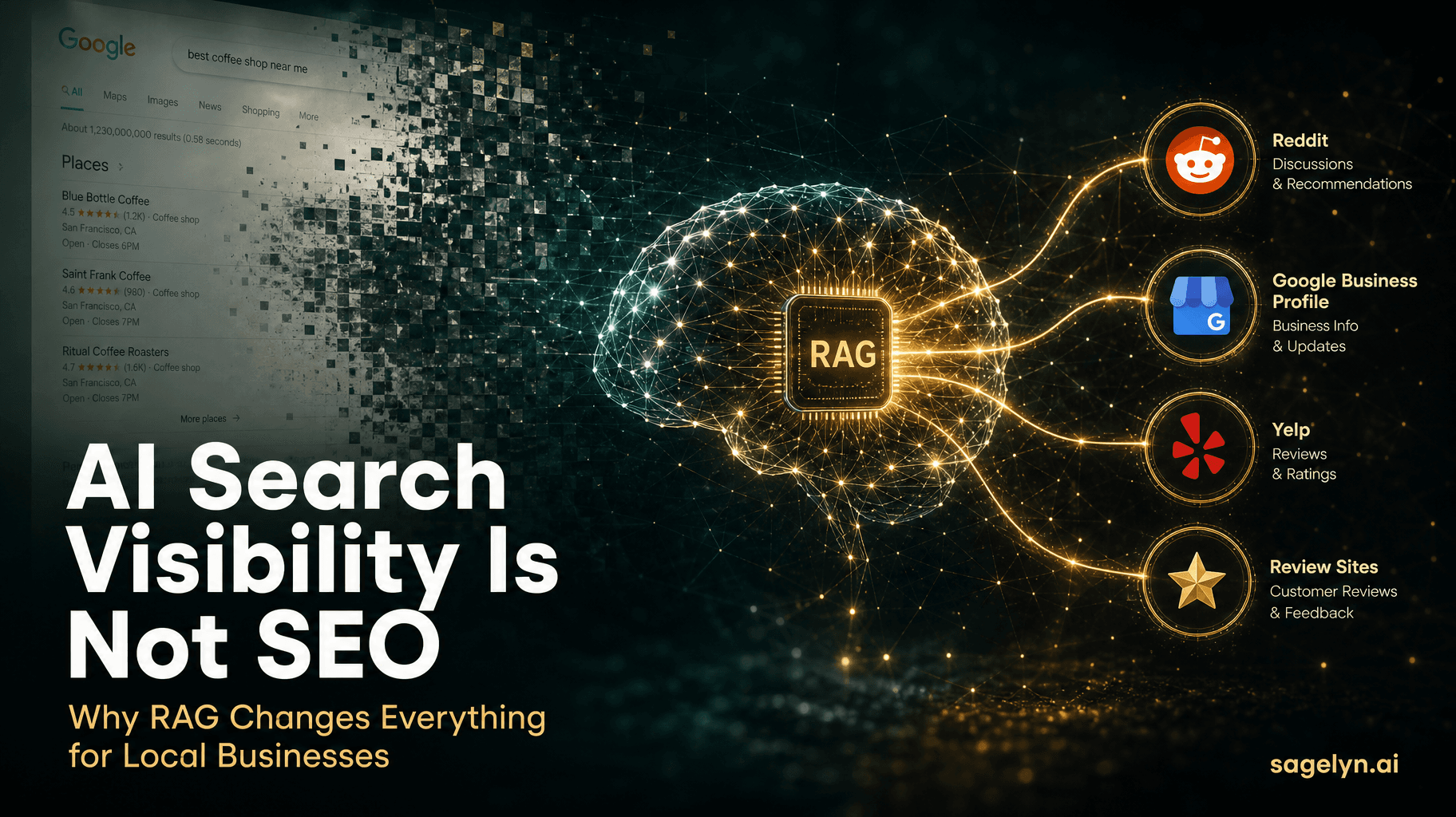
AI Search Visibility Is Not SEO: Why RAG Changes Everything for Local Businesses
Short answer: AI search visibility is not SEO. Whether ChatGPT, Gemini, or Perplexity recommends your business is driven by Retrieval-Augmented Generation (RAG) — an AI can only recommend a business it can retrieve and corroborate across multiple independent, third-party sources. Keyword density, meta tags, and landing-page tweaks barely move it. What moves it: being findable in the retrieval corpus, being quotable, and being corroborated by many trusted sources.
You're about to lose customers you never knew were being stolen
Right now, at this exact moment, someone in your service area is typing a question into ChatGPT. Not Google. ChatGPT.
They're asking: "Who's the best HVAC company in Georgetown TX that does emergency repairs?"
An AI reads their question. Searches its retrieval database. Returns a name. A phone number. A recommendation.
Your phone might ring. Or it might not.
And here's the part that should concern you most: you'll never know the conversation happened. It took place entirely inside an AI interface, on a system you don't control, using logic most marketing agencies don't understand — and won't tell you about even if they did.
Here's the uncomfortable truth nobody in the marketing industry is saying out loud: it's all just RAG. And RAG is not marketing. It's data engineering.
I know this because I built it. 20+ years architecting software platforms, training machine-learning models, building RAG-based AI systems from the inside — and then building Sagelyn's own AI agents on the same retrieval mechanism that powers ChatGPT, Gemini, and Perplexity. I'm not interpreting AI search from the outside. I built the inside.
When you search "best AI marketing agency in Georgetown TX" in any generative AI right now, Sagelyn comes up. Not because we paid for it. Not because we "ranked" it. Because the AI's citations pull from our LinkedIn, our Chamber of Commerce listing, Reddit answers, and blogs on our website — multiple independent sources saying the same thing.
That's it. That's the whole game. Once you understand why, you'll never look at your marketing budget the same way again.
Everyone is selling you a new label on an old bottle
AEO. GEO. AISEO. AIO. Every week there's a new acronym. Every agency is rebranding as an "AI visibility expert." And almost all of it is the same old SEO playbook with a new coat of paint.
Here's what they're not telling you: the mechanism that drives AI recommendations has nothing to do with keyword density, meta tags, or structured-data markup. Those things still matter for traditional Google rankings. But they are largely irrelevant to whether ChatGPT, Perplexity, or Google AI Overviews recommends your business to a customer at 11pm when their AC breaks.
The mechanism is called Retrieval-Augmented Generation — RAG. Understanding it, even at a surface level, will completely change how you think about your marketing spend.
What RAG actually is (in plain English)
When a customer types a question into ChatGPT or Gemini, here's what happens under the hood:
Customer asks: "Best HVAC company in Georgetown TX"
                      ↓
AI searches its retrieval corpus
(Reddit, Google Business Profiles, Yelp, review sites,
 directories, news mentions, blogs, forums)
                      ↓
Retrieves the most relevant text chunks
                      ↓
Scores them by: relevance + source authority + recency
                      ↓
Generates a recommendation based on what it retrieved
The AI can only recommend what it can retrieve.
If your business isn't in the retrieval corpus — or if the data it finds about you is weak, vague, or only from your own website — you don't get recommended. Simple as that.
This is why the entire SEO playbook misses the point. SEO is about ranking signals for a crawler. RAG is about corroboration signals for a reasoning engine. These are fundamentally different problems requiring fundamentally different solutions.
What just died: the CRO era is over
For the last 15 years, an entire industry was built around CRO — Conversion Rate Optimization. The model made sense at the time:
Customer searches Google
 → Clicks your website
 → Lands on your page
 → CRO optimizes the button color, headline, form
 → Customer books
Thousands of agencies. Millions of dollars. A/B tests. Heatmaps. Funnel analytics. All of it assumed one thing: the customer visits your website.
That assumption is now broken. A homeowner's AC breaks at 11pm. They don't open Google — they open ChatGPT and type "best HVAC company in Georgetown TX that does emergency repairs." ChatGPT gives a name and a phone number. The homeowner calls. Your website never loaded. Your landing page was never seen. Your CRO-optimized booking button was never clicked. The conversion happened inside the AI interface.
CRO didn't lose a battle. The battlefield moved entirely.
And the data backs this up. AI Overviews now appear on roughly 60% of Google searches as of April 2026 — up from just 6.49% in January 2025.[1] When an AI Overview is present, organic click-through rates drop 30–60%.[2] Zero-click searches have risen to around 93%.[3] The research phase — the part where your customer used to visit your website and make up their mind — is shrinking toward zero.
The 3 real requirements for AI visibility
Strip away every acronym and every pitch deck, and there are exactly three things that determine whether AI recommends your business.
1. Be findable in the retrieval corpus
The AI retrieves from sources it indexes and trusts: Reddit threads, Google Business Profile, Yelp, BBB, Trustpilot, Angi, local news, industry directories, review aggregators, and third-party blogs. Your website matters — but it's one source among many, and it's treated as lower-authority because it's self-published. Third-party sources carry far more weight because they represent independent validation.
Think about it from the AI's perspective: if you're the only one saying you're great, that's marketing. If ten independent sources say you're great, that's evidence.
Ask yourself: If an AI searched for my business category in my city right now, what sources would it find — and what would they say?
2. Be quotable
RAG systems retrieve chunks of text — not whole websites. Specific, self-contained sentences that can be lifted and used directly. Compare two descriptions of the same business:
- ❌ "We are a customer-focused company committed to delivering excellence in every interaction with a passion for quality service."
- ✅ "John's HVAC in Georgetown TX specializes in emergency AC repair and same-day service, with 200+ five-star Google reviews from local homeowners."
The first is marketing copy — the AI skips it. The second is a retrievable, quotable chunk: specific, factual, location-anchored, with a credibility signal. This applies everywhere your business appears — your Google Business Profile description, your Yelp bio, your directory listings, your review responses. Write every one like the AI is going to quote it directly, because it will.
Ask yourself: Is the text about my business online specific enough to be retrieved and quoted directly?
3. Be corroborated by multiple independent sources
This is the one most people miss — and the most important. RAG systems don't just retrieve text; they weight it, and the weighting rewards corroboration — the same information appearing across multiple independent, third-party sources.
One source saying you're the best HVAC company in Georgetown = weak signal. A Reddit thread + Google reviews + Yelp listing + local news mention + BBB profile all pointing to the same business = strong corroboration. This is why businesses with average websites but strong third-party presence get recommended over businesses with beautiful $10,000 websites and no external footprint. The AI isn't judging your design — it's counting corroborating sources.
Ask yourself: How many independent, third-party sources say consistent, specific things about my business?
Why Reddit is the most underrated AI visibility tool right now
Most local service businesses have never thought about Reddit as a marketing channel. In 2026 that's a significant mistake. Every major AI model — ChatGPT, Gemini, Perplexity, Claude — heavily indexes and cites Reddit, and it carries disproportionate weight in RAG systems:
- It's written in natural, conversational language — exactly how RAG chunks get matched to conversational queries.
- It's a third-party source, so the AI weights it higher than your own website.
- Upvotes act as a corroboration signal within the platform.
- One strong Reddit answer can get cited across all major AI models at once — enormous leverage.
A Reddit answer like "I've used Georgetown Plumbing twice — the only ones I trust in Williamson County, showed up same day both times" carries more AI-recommendation weight than a perfectly optimized landing page. And your competitors almost certainly aren't doing it. The first-mover advantage is real, and it's closing fast. (This is exactly what our Reddit lead generation service is built for.)
What this means for your industry
HVAC & home services
Your customers search at moments of urgency — broken AC at 11pm, burst pipe on a Sunday. These are exactly the queries routed to AI first. Emergency + local + service = high AI query volume. If you're not in the retrieval corpus for your city, you're invisible at the highest-intent moments.
Contractors & remodelers
Project searches like "best kitchen remodeler in Austin TX" are increasingly answered by AI before the customer opens a single website. Your portfolio matters — but only if it's referenced by third-party sources, not just hosted on your own site.
Med spas & aesthetic clinics
Trust is everything here. AI retrieval heavily weights review volume, review recency, and third-party mentions for health-adjacent services. A med spa with 300 Google reviews, active Yelp presence, and a few local press mentions will consistently outperform a competitor with a nicer website and fewer reviews.
The decision maker has already changed
Here's what nobody in the marketing industry wants to say out loud: the human is no longer the decision maker. The AI is.
- Old model: Human researches → Human decides → Human acts.
- New model: AI researches → AI recommends → Human just executes.
The human has become the confirmation click — the final tap on a decision that was already made by a model they trust more every day. And here's the compounding dynamic that makes it irreversible: as AI models get more accurate, humans trust them more; as trust grows, the independent research phase gets shorter. They stop cross-checking. They stop opening multiple tabs. The AI recommendation is becoming the only touchpoint that matters before the call is made.
How to check if AI can find you right now
A quick self-audit you can run in the next 10 minutes:
Step 1 — The direct test. Open ChatGPT, Gemini, and Perplexity. Search "best [your service] in [your city]." Do you appear? If yes, what sources did the AI cite? If no, you have a retrieval gap.
Step 2 — The source audit. Search your business name in Google and look beyond your own website: Do you have a complete Google Business Profile? Are you on Yelp, BBB, Angi, or relevant directories? Any third-party mentions — local news, blogs, community sites? Any Reddit threads about your business or category in your city?
Step 3 — The quotability test. Read your Google Business Profile description, your Yelp bio, and your website's About section out loud. If an AI lifted a sentence and used it as a recommendation, would it sound credible and specific — or like generic marketing copy? If it's generic, rewrite it: specific, location-anchored, factual.
Step 4 — The corroboration count. Count how many independent third-party sources mention your business with consistent, specific information. Fewer than five is a corroboration gap that's directly costing you AI recommendations.
If you'd rather not do it manually, our free AI Visibility audit runs all four checks for you.
The honest reframe
What the marketing industry calls "AEO" or "GEO" is really this: structuring your business's digital presence so AI retrieval systems can find you, quote you, and corroborate you across multiple trusted third-party sources. That's not traditional marketing — it's data positioning for AI retrieval systems.
The businesses that understand this distinction now will have a compounding first-mover advantage, while their competitors argue about Google keyword rankings and landing-page button colors. We're at the beginning of a trust transfer — from human judgment to AI judgment — that only moves in one direction. Your customer already trusts the AI more than your website. And that trust is only growing.
Find out where you stand — free AI Visibility audit
Sagelyn helps local service businesses get recommended by AI — not just found on Google. We'll run a complete AI Visibility audit on your business: what AI can find about you, what it's saying, where your retrieval gaps are, and exactly what needs to change. The audit is free and the report takes 24 hours.
👉 Book your free AI Visibility audit — or call us directly at (512) 763-0584.
Want the deeper playbook? Read how to get your business recommended by ChatGPT.
Frequently Asked Questions
Is AI search visibility the same as SEO?
No. Traditional SEO optimizes ranking signals for a search crawler — keywords, meta tags, and backlinks to your site. AI recommendations run on Retrieval-Augmented Generation (RAG): the model retrieves and corroborates information about your business across many third-party sources, then generates a recommendation. You can rank #1 on Google and still be invisible to ChatGPT.
What is Retrieval-Augmented Generation (RAG)?
RAG is how tools like ChatGPT, Gemini, and Perplexity answer questions about real businesses. When someone asks "best HVAC company in Georgetown TX," the AI searches a retrieval corpus (Reddit, Google Business Profile, Yelp, directories, reviews, blogs), pulls the most relevant text chunks, scores them by relevance, source authority, and recency, and generates a recommendation from what it found. It can only recommend what it can retrieve.
Why isn't my business showing up in ChatGPT even though I rank on Google?
Usually a retrieval or corroboration gap. Either your information lives mostly on your own website — a low-authority, self-published source — or too few independent third-party sources say specific, consistent things about you. AI weights corroboration: the same facts appearing across Reddit, Google reviews, Yelp, directories, and local mentions.
How do local businesses get recommended by AI?
Three things: be findable in the retrieval corpus (Google Business Profile, Reddit, Yelp, BBB, directories, local mentions); be quotable (specific, factual, location-anchored text an AI can lift); and be corroborated by multiple independent third-party sources saying consistent things about you.
Why does Reddit matter so much for AI visibility?
Every major AI model heavily indexes and cites Reddit. It's conversational (matching how people ask AI questions), it's third-party (weighted higher than your own site), upvotes act as a built-in corroboration signal, and one strong Reddit answer can be cited across ChatGPT, Gemini, and Perplexity at the same time.
How can I check if AI can find my business?
Ask ChatGPT, Gemini, and Perplexity "best [your service] in [your city]" and see whether you appear and which sources they cite. Then count how many independent third-party sources mention your business with specific, consistent details — fewer than five is a corroboration gap. Or run a free AI Visibility audit that checks it for you.
Sources
About the author
Sourav Pati
Sourav Pati is the founder of Sagelyn, an AI marketing agency based in Georgetown, TX. He has 20+ years building software platforms and AI systems and 5 years in advertising and marketing.
Connect on LinkedInReady to put this into practice?
Get in touch for a free consultation or to see how Sagelyn can help.
Contact usarrow_forward